The Privatization Programme in Kazakhstan is being implemented to strengthen the foundations of a market economy. The main objective of the programme is to stimulate further development of private business in the country and reduce the state’s share in the economy. More detailed information about the Privatization Programme is available here.
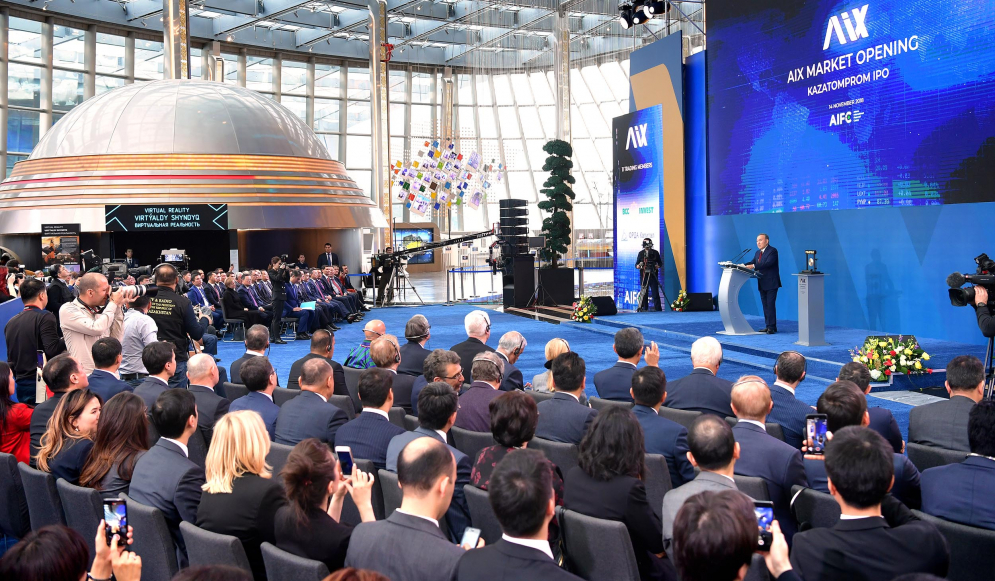
One of the world’s largest uranium producers, National Atomic Company Kazatomprom, became the first company to list on AIX and LSE in 2018 as part of the Privatization Programme. Subsequently, Kazatomprom conducted two SPOs, resulting in a free float of 25%.
In 2022, the IPO of NC KazMunayGas JSC was held on AIX and KASE. It became the largest IPO in the history of Kazakhstan’s stock market in terms of investor demand and capital raised. The IPO demonstrated the strong potential of the Kazakhstan’s market, as well as a significant increase in the financial literacy and investment activity of its citizens. AIX placed particular focus on its retail investor base, with direct subscription available via the Tabys mobile application and Kazpost branches. Trading in KMG ordinary shares on AIX commenced on 8 December 2022.
In November 2023, ordinary shares of KEGOC JSC, the national electric grid operator of Kazakhstan, were listed on AIX. Approximately 54% of subscriptions for the SPO on AIX came from retail investors through direct subscription in Tabys and mobile banking applications, with total applications amounting to KZT 2.2 billion.
In February 2024, the national air carrier Air Astana completed its IPO. The company raised $370 million across three exchanges: AIX, KASE, and LSE. Following allocation, investors on AIX acquired GDRs worth $71.6 million (KZT 32.4 billion) and shares worth KZT 15.6 billion. Retail investors accounted for 56% of the allocation on AIX, while institutional investors represented 44%.
Air Astana’s IPO established several milestones: it was the first IPO conducted simultaneously on three exchanges; for the first time, the number of applications from local investors exceeded those from foreign investors; and for the first time, local retail investors demonstrated such a high level of participation.